Welcome to Zannerpalooza World Tour 2011

Welcome to Zannerpalooza World Tour 2011! As many of you know, I have the good fortune of taking a year off to travel. Please enjoy my thoughts, rants and the occasional photo from parts of the world that are new to me. Please tolerate the lack of literary genius that sprawls these pages.


Thursday, December 15, 2011

Run Zanner Run!

In the center of Addis Ababa is Meskel Square, an outdoor plaza that looks like an amphitheatre with many escalating levels or stairs.   Meskel Square is not only a community gathering place, it is where the Ethiopian runners train.

Meskel Square view from the top.

Looking up at the stairs of Meskel Square.
Side view - each level stretches for a long way.

If you run the entire length of each level of the square, referred to as the stairs, you will complete a marathon!  Olympian Haile Gebrselassie trained at Meskel Square, and I saw many young athletes training to follow in his foot steps. 

I chatted with some of the athletes and they were friendly and welcoming.  They were also not shy in sharing how ripped their bodies are!   
Steven and I chatting with the athletes.

Gold medal for nice abs!

Steven showed his stuff as he joined the athletes in some push-ups down the stairs. 

Steven kicked butt on the young guys!!

I could not stop by this historic landmark and not participate.  The video below captures it all!

Tuesday, December 13, 2011

Coffee Ceremony

As mentioned earlier, coffee was originated in Ethiopia and plays a very central role in the Ethiopian culture.  They don't just serve coffee...they present a coffee ceremony.

The ceremony involves a little table filled with small ceramic cups that look like mini bowls.  Off to the side is a little barbecue filled with  charcoal. 

Coffee ceremony set-up outdoors at Alemgena.
Coffee ceremony set-up at the home of friends Jeri and Abiy.
The woman making the coffee sits in front of the table with the barbecue off to her side.  She roasts the fresh coffee beans and fans the charcoal on the small barbecue.  On a second small barbecue she boils water in a ceramic jug.  A third barbecue is used to burn incense.  This fills the house or restaurant with a smokey haze and an amazing aroma.  

There are baskets surrounding the table and cups.  One basket always has popcorn, which is also believed to have originated in Ethiopia.  The others contain herbs and spices like cloves, cinnamon and cardamom which are added to the coffee.

The beautiful Jeri at home, where she served us coffee in a wonderful aromatic haze.
Once the coffee is roasted the beans are ground with a mortar and pestle.  The ground coffee is then added to the ceramic jug of hot water.  After brewing, a small amount is poured into one cup, which is then transferred back into the jug once it is determined the coffee is ready.  A full cup is then poured, and the liquid contents of that cup are transferred to a 2nd and 3rd cup.  This process of pouring from one cup to another continues.  I believe this is to remove the grinds and collect the majority of grinds in one of the cups.

Coffee ceremony for hundreds of people at Yod Abyssinia Restaurant.

Coffee is served black in the small cups with raw sugar and a sprig of leaf from a plant called "Adam's Healer" - it helps with tummy troubles.  The coffee is very, very strong!

Quite often the coffee is served as a macchiato, which I guess is one positive effect of the Italian invasion on Ethiopia.  The quality of the macchiato makes up for the lacking pizza!

Fresh coffee macchiato and a sprig of Adam's Healer.

Friday, December 9, 2011

Ethiopians Can Dance!

One thing I did not know about Ethiopians prior to my trip, was their love of dance.  I really enjoyed watching the traditional Ethiopian dances on the stage at the Yod Abyssinia Restaurant (that I went to 3 times I like the dancing so much!).

Ethiopian dancing is referred to as dancing from the shoulders.  They can pop their shoulders better than any b-boy.  I will hedge a guess and say break dancing has it's roots in Ethiopian culture. 

Yod Abyssinia Restaurant hosts a full crowd every night.  The crowds are there to see the performers demonstrate music and dance styles from the different ethnic groups within Ethiopia (Tigray, Gurage etc.).  The highlight for me was always the Gurage women who spin their hair around at high speeds - that takes talent (and a really strong neck)!

As I spent time with the children in our programs, they would often dance using the cultural moves that have been passed down from generation to generation.

During one of our visits to Yod Abyssinia, a performer was kind enough to give me some one-on-one dance lessons.  I was dismal.  Due to my poor performance, I vow to return to Ethiopia so I can hone in on my shoulder moves.

Below is a collection of some of the dancing I saw - which was certainly a highlight of my trip.


The Project Management of Hawaiian Pizza

Prior to leaving Canada, the expedition coordinator (Deb) asked if I could present a half-day course on Project Management.  I was more than happy to speak on behalf of what I love to do, and processes I strongly support and believe in.  I prepared some handouts and brought all course materials from Calgary.

Zanner leading a discussion on Scope, Time and Cost.

Canadian Humanitarian has Project Managers representing each project (YTH, BEKA, LIGA, PATH, SSCM).  These Project Managers joined our team for a great session on Scope/Time/Cost and the Work Breakdown Structure (WBS).  The course was held in the library at the SSCM Vocational Center.

Group 1 working on their project.


Group 1 presentation of their WBS for a Medical Clinic project.

Group 2 working away.


Group 2 presenting their WBS for a New Farm.
Group 3 deep in thought.

Group 3's presentation was a WBS for an Expedition.

It was interesting putting on a course with a translator, and working within cultural differences.  I appreciated the challenge and it was a rewarding experience, even if I did get some interesting resistance from elder members of the team.

While at Gindo I had also put on the same half-day course for the BEKA Guardians and Foresight Fathers.  It's not very often I get to create a Work Breakdown Structure in Amharic.
Amharic WBS - too cool!

After the course, the team stopped at a restaurant for a quick lunch.  It was an interesting experience.  Bryce and I ordered a Hawaiian pizza to share.  When it arrived - the pizza had no toppings on it.  I asked the waitress where the pineapple was? -  "No pineapple".  I asked the waitress where the ham was? -  "No ham".  Ummm... OK, cheese pizza it is!  And yes, they billed us for a Hawaiian pizza.  Serves us right for ordering Polynesian Italian food in Ethiopia.

We headed to the PATH center after lunch (PATH is the center where we delivered the flour and oil last week).  We completed more one-on-one interviews with the children.  I especially enjoyed my discussion with Tamrat who is 18 and working hard at school as he wants to become a lawyer.  His english is fantastic and he acted as my translator for my interviews with the younger children. 

Tamrat and I had a great conversation about soccer, travel and life in Canada.  I loved watching his expression as I explained that during winter we have to warm up our cars in the morning, after plugging them in overnight.  We chatted about Canada's amazing healthcare system.  For someone who has not grown up in our country, or experienced any form of socialist government program it was an interesting task to explain how it works.  When we talked about healthcare and Canadian taxes, he asked some great questions, like:  "When you go to the doctor or the hospital - do you have to pay for your own transportation?".  Thoughts like that never crossed my mind before.  This young man is going places and can't wait to monitor his progress in the years to come.

Another amazing student is a girl named Helen, who is first in her class.  As part of our interviews, we asked the children what they were most excited about.  Her response was the new hydroelectric dam that Ethiopia is building on the Nile.  She wants to be a scientist when she graduates. 

Students like Tamrat and Helen give me the confidence to know, first hand, that the Canadian Humanitarian programs are working.  These are amazing students who are going to be contributors, and not consumers.  I am so excited, motivated and hopeful when I think about the future for these kids, and for Ethiopia.

Wednesday, December 7, 2011

Red Berries and a Rock Church

Our team leaders were kind enough to give us a day off today.   Steven, Nicole, Bryce and I decided as a group to hike to the rock hewn church of St. Michael and see a panoramic view of Addis Ababa.  The hike had quite a gain in elevation.  I was pretty winded and tired so I blamed it on the altitude!

The hike started at the base of the temple of St. Michael, at which there was a market and many people selling vegetables, spices and other goods. 

Market stall at the base of our hike incase you need a sparkly umbrella.
Entrance to St. Michael's Temple.

We paid for a guide (who looked like Morgan Freeman), and he was dressed in a suit and came complete with a Kalishnikov rifle!  I question the need for the rifle as I always felt very safe when in Addis Ababa, I think it was just for show and a way to justify the cost of the guide. 

Even though the rifle was just for show, I was still to chicken to take a photo of our guard.
This sneaky photo from behind was all I got.
 Two seconds later, Steven got to hold the rifle!
The hike was gorgeous and took us up through a road and eventually into a eucalyptus forest.  At the top we noticed a fenced area with several modern buildings.  Behind the buildings we saw an outdoor Ethiopian Orthodox church service with familiars hymns being sung in Amharic.  Just past the gathered church-goers, was what appeared to be a field and some rocks.
Bryce hiking the road to the church of St. Michael.

Eucalyptus forest.
  I would crush the leaves in my hand to smell the refreshing menthol-like oils.

What was surprising is that those rocks used to be a church.  The structure dates back to 328 so it is over 1600 years old.  The craftmanship is incredible as the church is monolithic and made from one solid piece of stone.  The rock is approximately 7 meters high, and is a single unit - not a collection of large boulders.  It was really cool to imagine how they built this church, and to compare the architecture to the work of the Incas I saw in Peru. 

Rock hewn church of St. Michael.

The church used to have a roof and two levels, but the WWII bombing by the Italians destroyed part of the structure and the roof is no longer.  You can still clearly see the 7 windows that symbolize 7 angels and the 7 days of the week. 

There is a cavern in the rocks where it is believed the Arc of the Covenant was stored.  Although probably inappropriate - we were permitted to crawl into the cavern.  A once in a lifetime opportunity!

Cavern that supposedly hid the Arc of the Covenant.

Women weren't allowed into the sacred second floor room that was reserved for the priest and the king.  As a result - we could see a window that was used for baptisms.  The babies were passed in through this window to the priest, and were baptized while the parents waited outside.

As the rock-hewn church is on the top of a large hill, we were able to get a nice panoramic shot of Addis Ababa.


After our hike, we were hungry and thirsty.  We stopped at the only North American looking business that I noticed in Addis:  Kaldi's Coffee.  It looks surprisingly similar to another famous coffee chain that originated in Seattle.  However, the story behind Kaldi's is quite intriguing. 

Entrance to Kaldi's Coffee...hmmm..something familiar here...
Logo (no mermaid though).

Kaldi is known in Ethiopia as the first man to invent coffee.  The legend is that Kaldi, a goatherd, noticed his goats eating red berries.  The goats would get very energetic and would jump around after munching on the red berries.  Kaldi decided to try the berries himself, and was amazed at the increase in his energy levels.  When he approached the religious leader of his community with the berries, the leader was against eating the berries and threw them into the fire.  And there you have it...the first ever roasted coffee bean.

Some people say that Kaldi's Coffee houses originated first.  I am not sure if that is true or not.  We pondered this question over our machiattos and chai latte and a plate of french fries.  A small taste of home!

Nicole, Ketema and Zanner at Kaldi's.
Our drinks, YUM!

Our day of adventure was topped off with a nice dinner at a restaurant called Makush with Deb & Dr. Northcott.  Makush serves Italian food and is also an art gallery.  The chocolate mousse is to die for!

Tomorrow it is back to work, and I will be presenting a half-day training course on one of my favorite subjects: Project Management.

Tuesday, December 6, 2011

Dama: To The Top!

Today is our last day in Woliso and Gindo.  I must admit I am not sad to say goodbye to my rock hard bed and cold showers.  Definitely sad to say goodbye to the amazing people I have met here.

Our day started with the completion of interviews and medicals with the BEKA children.  Each child was given a care package which included their photo, some soap, a toothbrush and a soccer jersey.  What would our last day in Gindo be without putting those new soccer jerseys to good use?

Deb assembled the BEKA children in a clearing near the construction site for the education center.  The children were excited to play two soccer games:  boys vs. boys and girls vs. girls.  I was pleased to see many people from the community gathered to watch the games.  We must have had fans in the hundreds (and one cow). 
Can you spot the soccer fan cow?
With Bryce as the referee and Deb as the scorekeeper, the kids put on an amazing show.  The kids played their hearts out in their new jerseys and bare feet.  These kids are really, really good at soccer - they have all the fancy moves.  The younger children who were too small to play soccer cheered on the sidelines.


After a tearful goodbye following the soccer game, our team made our way back to Addis Ababa.  Along the route home, we made a stop at Lake Wenchi.  This lake is at the bottom of a huge volcanic crater.  The crater is higher in the mountains than Gindo and was noticeably green and lush.  The lake was a beautiful blue against a green backdrop. 

The approach to Lake Wenchi.
Getting closer...
Beautiful!
We walked down to the lake from the top of the crater, approximately a 300 meter descent in 35 minutes.  It was a great workout! 
Jumping pictures are a workout too!  (Nicole, Steven and Bryce)

It was very dusty due to all the volcanic ash.  Once at the bottom I was kicking myself for not having my swimsuit - that water was really inviting. 

Lake Wenchi Waterfront
Back L to R:  Mesfin, Bryce, Nicole, Abiy, Alex, Deb
Front L to R:  Zanner, Steven, Dr. Northcott

Due to the late time of day, we had to climb back out of the crater before darkness set in.  As a result we rented little horses to carry us up.  My little horse had her work cut out for her hauling my sorry a$$ up that hill!  There were no reins to hold onto, just a little knob on the saddle.  I white knuckled it the entire way, but my horse, "Dama" , got me to the top with only a few bruises (you know where!). 

"Dama - to the top!"


Monday, December 5, 2011

The Land of Comfort

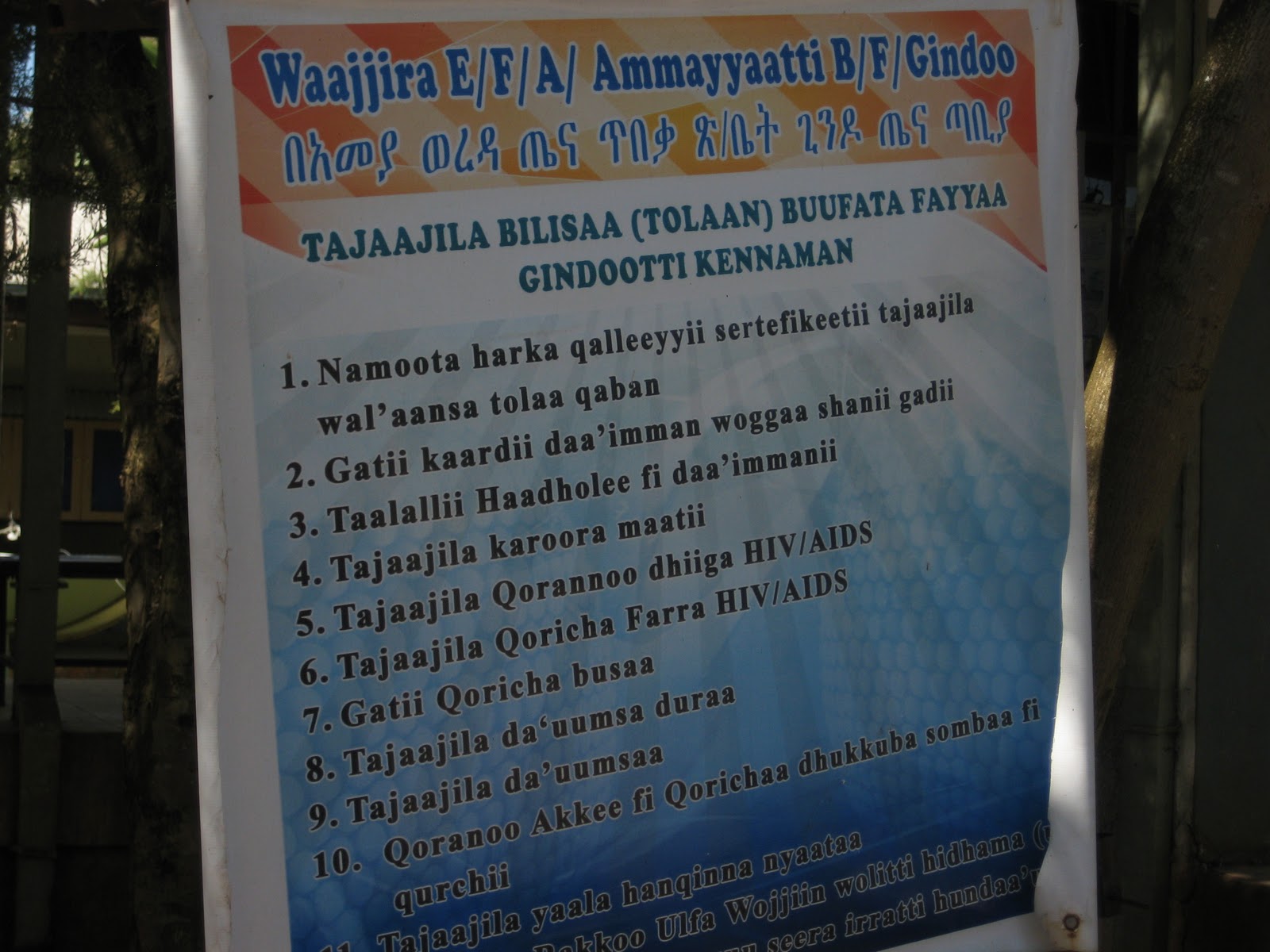
Today started off with a tour of the local medical clinic in Gindo.  The clinic is a U-shaped complex and the middle is an outdoor waiting area.  This clinic deals with Tuberculosis, Malaria, HIV/AIDS, and everything else in-between (cuts, bruises, births etc.).  There is no full-time doctor at the clinic.

Sign at clinic listing services available.
 

Stretcher.


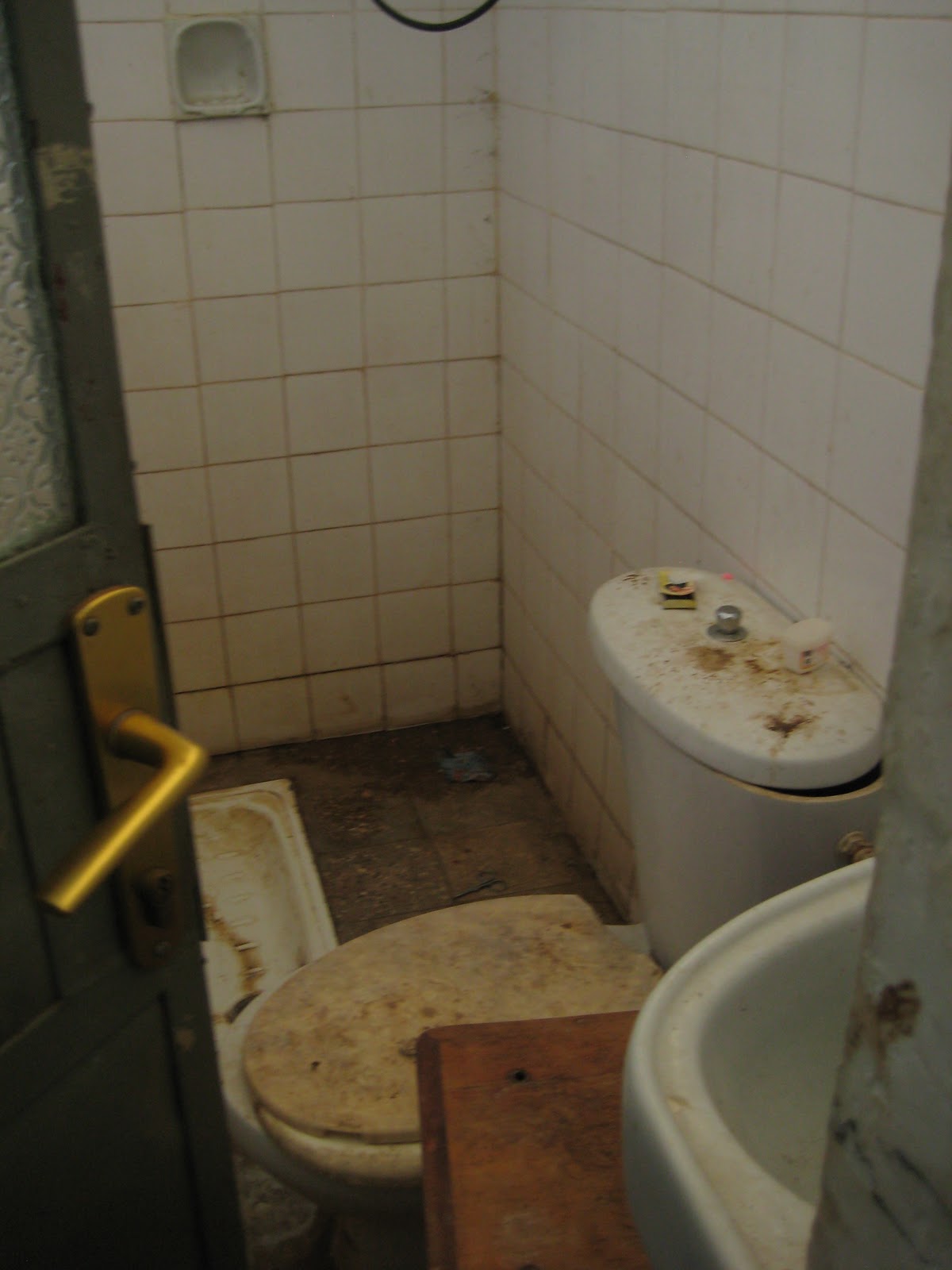
The clinic has a pediatric section as well as section for labour and delivery.  I must admit that I was quite shocked when I saw the lack or resources at the clinic.  The labour area has 2 wooden beds with no mattress, one blanket and a pillow.  The bathroom was so atrocious that I stayed outside of it to take my photo.  It's amazing what they can accomplish with so few tools, but I keep thinking how much easier it could be if we Canadians could share a bit more of what we have (and have in plenty). 
 

Labour room, 2 beds.  Most babies are delivered at home.


Delivery table.


Labour area washroom in disarray due to lack of resources to keep it clean and in-use.

The pharmacy at the clinic has one shelf, which was only about one third full.  The image of the empty shelf will stay with me as I feel very sad knowing we have so much back home.

As the team and I left the clinic, the little kids from Gindo walked with us.  They absolutely LOVE to hold your hand and touch any part of your body that they can reach (I got my fair share of butt slaps and giggles).  They fought over who got to hold my hand, and who had to settle for resting a hand on my forearm.  I was taken aback once again at how loving and generous these children are - they certainly are not afraid of strangers.  It is quite a breath of fresh air to give and receive affection with someone who you don't know, especially when you don't even speak the same language.

After the clinic we stopped at the garden.  I did a lame attempt at helping dig part of a compost pit at the garden.  I worked up a sweat and got really dirty; that red soil is tough!  I had barely any progress to show for my effort.  It was very humbling.


Nicole, Bryce, Steven and I put in a bit of sweat equity.
After the garden we made our way to the BEKA center.  Nicole presented a half-day course for the guardians and parents at BEKA.  The topic was grief (inward feelings) and mourning (outward actions).  I attended the course and was very grateful.  Nicole is a Social Worker with two University degrees.  She did a wonderful presentation on a very difficult subject while keeping in mind the cultural and religious barriers that may be present.  She delivered a message that many were grateful for, including myself.  I learned a lot.


Nicole presenting her course along with Alex (BEKA Project Manager) as interpreter.

At the end of the day I was invited to the home of two siblings in the BEKA program, Mebrat and Dawit.  It was such an honor to visit with their family, and see where they live.  The team engaged the mother in a conversation to make sure that all is well at home, and to see if there is any way we can help or assist. 

Seeing the homes of these amazing people did leave me with many feelings of guilt.  Why was I so lucky to be born in Canada?  Why do I have so much, and others so little?   I was brought out of my turmoil when a local  stated that the fact that the other volunteers and I left the "land of comfort" to help them, it inspires them to work harder.  It's not much, but in a way it made me feel a bit better.

That evening, back at the Woliso hotel, the power was out (again).  We had a lot of work to do preparing packages and donations for our last day at BEKA tomorrow.  It's amazing how much can be done by a motivated team under candlelight with a bunch of flashlights!
The hotel placed candles along the stairs and hallways throughout the building.
The group working away in the hallway of the hotel (Photo With No Flash).
The group working away in the hallway of the hotel (Photo With Flash).