Welcome to Zannerpalooza World Tour 2011

Welcome to Zannerpalooza World Tour 2011! As many of you know, I have the good fortune of taking a year off to travel. Please enjoy my thoughts, rants and the occasional photo from parts of the world that are new to me. Please tolerate the lack of literary genius that sprawls these pages.


Thursday, January 12, 2012

The Serengeti Of My Dreams

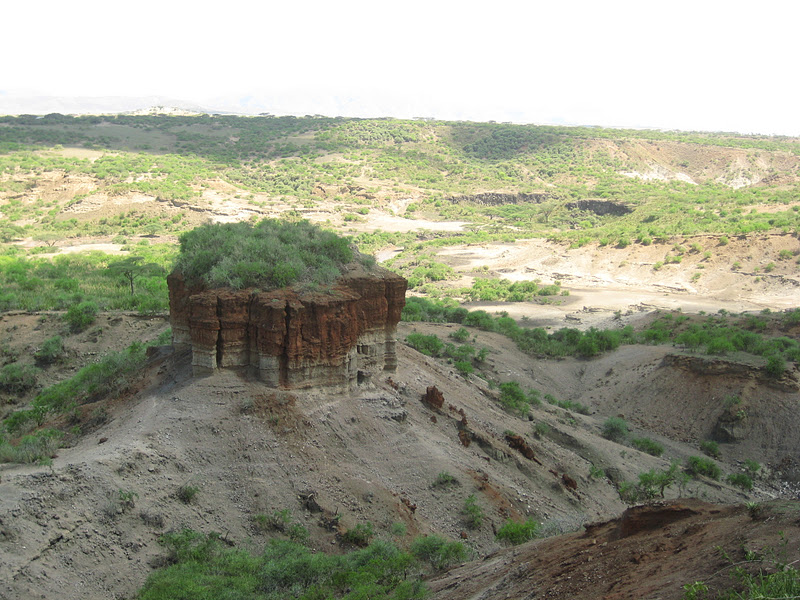
As we drove from Mto Wa Mbo we stopped by the Oldupai Gorge.  This eroded canyon has unique rock formations called monoliths, and some of them look like a castle.  This gorge is a well known archaeological site.
A monolith at the Oldupai Gorge.

Gorgeous!
We toured the Oldupai Museum and read about Louis and Mary Leakey, scientists who studied fossils from the gorge and uncovered skulls, bones and footprints of prehistoric man.  Geologists and archeologists would love to visit this gorge which is made up of centuries of history visible through five layers:  lava, ash, red rock, grey rock and top soil. 

Rhino skull at the Oldupai Museum.

I love the story behind the name.  In all the tour books, and our Intrepid Itinerary, the gorge is referred to as Olduvai Gorge.  The Africans informed me that the original Germans who "founded" this site, mis-spelled the name which is locally known as Oldupai.  Oldupai is the name of a plant that grows locally in the gorge.  Olduvai means nothing.  I can't believe after all these years, Europeans and North Americans still mess it up.

A few hours drive away from the gorge, we finally entered the Serengeti.  For me, this is the African destination I wanted to see the most.  This is the home of the Lion King, Pride Rock, and the lyrics to the song "Africa" by Toto.

Dreams DO come true!
A photo of the Serengeti from a hill at the National Park gates.
I found the Serengeti to be a lot flatter and more barren than the Maasai Mara.  It's vast openness took my breath away.  We immediately saw thousands of wildebeest running.  Wildebeest have a keen sense of smell, and a secretion in their hooves.  This allows the wildebeest to run extremely fast in a single line, the nose of the follower tuned in to the hooves of the wildebeest directly in front of him.  They simply put their head down, smell, and run! 

Thousands of wildebeest dot the horizon.

If I had a wildebeest I would name him Forrest.
That way I could cheer him on:  "Run, Forrest, Run!"
When I thought being in the Serengeti was exciting enough, we finally saw the elusive leopard.  Our first sighting was of four leopards lounging in trees.  Some were napping and some were snacking on the gazelle that they had killed and carried up to their tree top lounge.
Cat nap.
If that wasn't exciting enough, about an hour later another leopard walked right in front of our Land Cruiser.  Not so elusive after all!  It was a thrill to see the leopard up close and compare it to the cheetah I saw earlier in the week.

At last, Mr. Elusive.


The Serengeti is proving to the be highlight of my safari.  I must say though, anyone who enjoyed the '80's may have some misconceptions about the Serengeti due to misleading pop song lyrics.

Toto's lyrics state: "As sure as Kilimanjaro rises like Olympus over the Serengeti"  (http://www.youtube.com/watch?v=aCca5mPMp9A).  I was deeply disappointed to find out that you cannot see Mount Kilimanjaro from the Serengeti.  What's next, the Mini Pops aren't real?

Wednesday, January 11, 2012

Banana Beverages

Lake Manyara survived The Willies, and everything was back to normal in the morning.  We had another successful game drive with a few new sights.

African Starling.
Hornbill.
Monkey.
Those birds really do hang out on the back of hippos!
Suntanning hippos.
Before our trek to the Serengeti we spent some time in a small village named MTO WA MBU.  It's very important to say that name correctly.  In order to do that you must think back to when you were in elementary school, and how kids imitate the swallowing sound.  When you pronounce the M in Mto or Mbu, it is more accurate to pretend you are gulping instead of the mmmm sound.  Ha - I bet you are trying that out now, aren't you!


Mama Paray, from Mto Wa Mbu, worked very hard to welcome our group.  She prepared a hot lunch for us that included twenty different dishes. 

Mama Paray, our hostess.

Mama Paray hard at work cooking the meal.
She put together rice pillau with beef, white rice with coconut milk, spinach, fried banana, bananas in broth, aubergine in coconut milk, beans and maize, cabbage to name a few.  All dishes were served warm in medium sized clay pots. 

Lunch spread at Mto Wa Mbu.
Mama Paray immediately got on my good side as she served banana wine!   It tasted like hooch.  The bottle did not get emptied.  Oh well, there's a first time for everything.

Banana wine bottle...first and last.
 The artists in Mto Wa Mbu had a small gallery that I really enjoyed.  It was great to meet the artists personally, and bring home some of his work to hang in my home back in Canada.
Artist Sino hard at work.
We stopped by a local banana beer hut.  Here the fermenting bananas were mixed with millet and the locals would stop by for a refreshing drink.  Here's the catch though, the beer is quite raw and is full of chunky particulates floating on top. 

Fermenting banana beer.
The locals taught us that you must blow on the beer before you take a sip.  This is not because it is hot.  Nope, the blowing helps push the floaties to the other side of the cup.  This has lead me to create a new personal rule.  Never, EVER, drink anything that involves blowing away floating chunks.

Greg is a brave man.

Tuesday, January 10, 2012

The Big Five

When on safari, everyone talks about The Big 5.  I did not know what The Big 5 were when I started my safari, but was quickly brought up to speed. 
Cape Buffalo, Leopard, Lion, Rhino, Elephant.
The nice thing about a safari is the bush telegraph.  This amazing piece of technology allows your group to know how the locate The Big 5 in the area.  The highly technical bush telegraph works when one Land Cruiser passes another oncoming Land Cruiser.  The drivers stop, chat, and compare notes:  "I saw a lion at the third rock past the river" or "Mambo veepee! There is a cape buffalo by Sampa Road".  Amazing technology for which we were very grateful.

By this point in the safari I was doing quite well, I had witnessed four out of five animals.  We had seen lions on several game drives, but the ever elusive leopard had yet to be checked off our list.

When I saw my first lion I was pretty excited.  The feeling was not mutual.  The only way the lion could not have been any less interested in our safari vehicle is if he were dead.  The lion was not directly facing us, and we made noise to entice him to turn and face us, yet failed miserably.  
Wake up Mr. Lion, watching you sleep is boring!

Sleeping lions.  Exciting...NOT!
At one point, our tour leader explained that if a lion has a full tummy - nothing else matters. Our guide bravely illustrated this point by stepping outside of our vehicle that was approximately 5 meters away from the lion.  He yelled "Hello Mr. Lion - Look a me!  I am tasty - come and eat me!".  Nothing.  The lion didn't even flinch or turn his head to glance in our direction.  Seriously, Mr. Lion?  Not even a side glance?  That kind of put me in my place.

We did have the good fortune of seeing a mother lion with her cubs.  


Mama lion and two cubs.
 We drove to Lake Manyara with the goal of tracking down more lions and the elusive leopard.  The lake is very alkaline and was 95% empty due to the lack of rain.  This created a huge alkaline ring with no growth or plant life around the lake.  However, outside of this ring the land was very lush and fertile, unlike the barren lands of the Maasai Mara.  There were trees, creeks, hills and valleys. 


Lake Manyara at sunset.
We found a family of elephants that were one meter away from the road.  When I first saw elephants at The Ark, I was so excited I lost the moment by trying to capture it all on video.  This time, I recognized the importance of setting aside some time for uninterrupted observing.  It was precious. The family had a little baby and it was amazing to watch the family dynamics.  Elephants are very human-like.  They have mammary glands by their front legs.  They also have glands near their ears from which they secrete pheromones. 
Baby elephant.
Mama elephant flaring her ears and raising her trunk. 
This stance shows she was ready to protect her baby if we got any closer.
Special secretion.


A family of baboons also put a show.  I find them quite ugly - especially the females that are in heat which is evident by their bulging, bulbous red butts.  One little baby stole my heart as he suckled his mom, then squealed when she just got up and walked away with him still attached to her.

Red rump of a female baboon in heat.


Our Lake Manyara Lodge was at the top of the escarpment with breathtaking views overlooking the lake.  After our morning game drive, the temperature was in the 30's, so we all retreated to the pool for a refreshing swim. 

Reflecting bridge over the pool at Lake Manyara Lodge.
Later that afternoon, we piled back into our Land Cruisers for a second game drive.  As we got to the bottom of the escarpment a gigantic dust storm brewed up.  I was face to face with a huge wall of red dust coming towards me like the Tanzanian Devil (Tasmanian Devil's cousin).  The dust covered everything and we could only see two meters ahead of the vehicle.  We decided to keep going until...

We got closer to the lake and were bombarded by the most disgusting smell I've ever experienced.  The wind swirls from the dust storm are known locally as the "Willies".  The "Willies" had picked up all the flamingo and hippo poo that had collected over the past years along the dry alkaline ring surrounding the lake. 

Smelly Willy.
I almost threw up the smell was so bad.  I had to put on a hat, my sunglasses and a scarf  around my mouth to keep out the dust.  I sat in the truck, huddled in fetal position with my eyes closed, repeating to myself "Keep you eyes closed and wait for it to be over, wait for it to be over".   I've never been sick because of a smell before.  Maybe a little gag here and there while changing a baby's dirty diaper.  This was different - it was acrid, rotten, pungent and very organic.
Thankfully because our lodge was up high on the escarpment, it was relatively stink free.  We will try again tomorrow for a game drive around Lake Manyara before we make our way to the Serengeti.  Hopefully the elusive one decides to make an appearance and the "Willies" are done stinking up the place.
African Rodeo Techniques

I must begin by saying that the restroom facilities in Africa are quite varied.  I saw everything from the traditional North American, to the pit latrine (aka - hole in the ground), to the squatter, to everyone's favorite...the bush toilet.  I cannot express how important it is not to rely on the bush toilet.  It basically means that you must sneak behind the truck and let 'er rip free style.  When you are surrounded by carnivores, it is a pretty risky task.


The Squatter.
Awesome version of the bush toilet that we only found once.
Pit latrine (sorry if this offends anyone, but it's real and I used it).
I must admit I was pretty rusty when it came to technique for the squatter.  My first intro to a squatter was in Italy (6 months ago) but I still was unable to master a true strategy.  Thankfully, my friend Thalys from Brazil provided me with some great pointers. 
Pay attention all you world travellers.  You will not learn this in any guide book or travel TV program.

Squatter 101

Using a squatter toilet is like being at a rodeo.  Anyone from Calgary will appreciate this.  The trick is to make sure that you or your clothing do not touch anything...anywhere!  First you start by rolling up your pant legs.  Second, when you are unzipped and preparing to lower, you gather your lowered trousers at knee level with your left hand.  This is similar to how a cowboy ropes in near the neck of the horse or bull, and is critical to making sure nothing hits the floor.

Great rodeo technique (photo courtesy of Wikipedia).
Thirdly you put your right hand above your head and move it back and forth, cowboy-style, to maintain your balance.  Remember, if you make contact with anything you will be disqualified.  Anything resembling a bareback, saddle bronc or bull rider is bang-on technique.  It's your choice whether you  yell "Yee Haw" or not.  Personally, I am in favor of shouting out a little "Pee Haw"!

Monday, January 9, 2012

Mama Gladness

It was another treacherous drive from the Maasai Mara back to Nairobi.  Once we arrived in Nairobi, we experienced the highlight of our day.  We got to ditch the uncomfy overland truck.  Our new land cruisers had leopard print seat covers to boot.  Now we're travelling in style!

Riding in style - Toyota Land Cruiser.

Lada Gaga and Mic Jagger must have given up a few pair of pants to allow for these seat covers!

Our time in Kenya had ended, and we were off to the third country in my African adventure:  Tanzania.  We drove from Nairobi, Kenya to Arusha, Tanzania (which is exactly half way between Cairo and Cape Town).  In Arusha we met our new tour guide, Jerry.  Jerry informed us that "Jambo!" is the tourist way of saying hello in Swahili.  The locals actually say "Mambo veepee!" to which you can respond "Mambo poah!".  "Karibu" means welcome and "sawa sawa" means OK.  I love being one up on all those new freshmen tourists.

Once in Arusha we stopped at a village outside of the city.  Here we visited quite an innovative farm.  We met  Mama Gladness and Joshua who gave us a tour of their operation.


Zanner and Mama Gladness - check out her ride (back left)!
The farm has cows, sheep and goats.  All the livestock manure and waste is collected and turned into fuel.  A large underground tank holds all the bio-waste. 
Bio-waste collection bin.
Cattle pen with waste collection off to the right.
I felt really bad for the guy who had to stir the poop with his arm.
The fermentation and degradation process creates pure CH4 methane gas.  The gas bubbles to the top of the tank where it is redirected into a small steel pipeline.  The pipeline circulates the methane through a filter to remove any water droplets.  The dry gas is then taken to two burners in a cooking hut near the kitchen.  I have heard of bio-waste-fuel before, but have never seen it implemented.  It's amazing how simple it is.
Collection ditch.
Collection trough leads to the underground tank.
The pipeline that takes the gas fromt he tank to the cooking hut.
Beyond the farmyard is a large field with acres and acres of land.  The land is chocked full of coffee and banana trees.  Joshua explained to us that the banana trees are needed to protect the coffee beans by providing shade and preventing the rain drops from knocking the coffee beans to the ground.

Joshua teaching us about coffee and bananas.
The red husks on coffee beans.
Coffee beans are harvested once a year.  We picked some beans and took them back to the farm with us.  The banana trees only provide fruit once, after which the banana trees are knocked down.  This is sawa-sawa (OK) because each tree can provide up to 100 bananas.

Hey Mr. Tallyman, Tally me Banana!
New shoots can been seen in the old banana tree stumps after two weeks, and a full banana tree will be in place after 3 to 4 months.  This means all the more bananas to make banana beer and banana wine.

Back at the farm we learned how to hull our coffee beans, roast and grind our own coffee.  Greg and I took turns stirring the beans while roasting.

Good technique, Greg.
I got my workout with the mortar and pestle.
Mama Gladness and Joshua ground the roasted beans while singing their traditional coffee song.


I tried a sip of Greg's coffee (I am not a coffee drinker).  It was sawa sawa - thank goodness for cane sugar!  Now where can I get my hands on some of that banana wine?

Cheers!  The envy of Juan Valdez.